What year(s) did you do the fellowship?
2021/2022
2022/2023 (Advanced)
What sport organizations, teams, or associations have you been involved with throughout your career?
- Western Athletics
- Fanshawe Athletics
- Fowler Kennedy Sport Medicine Acute Injuries Team
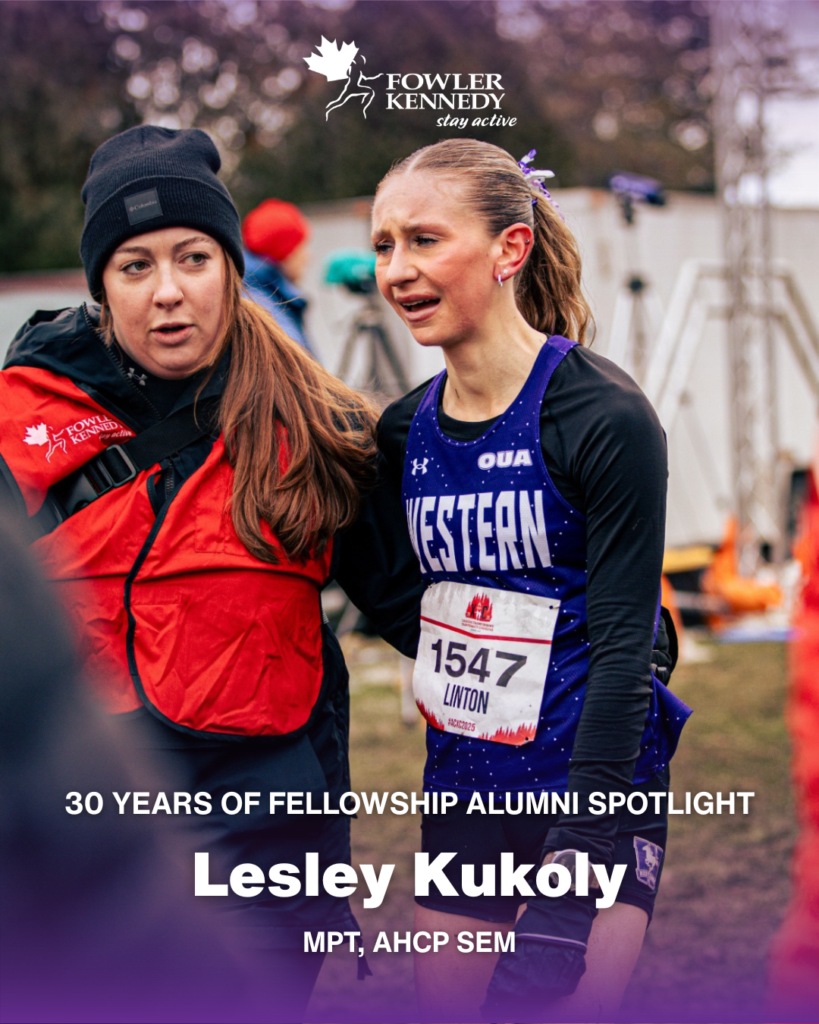
- Chief Medical Officer at the Canadian Cross Country Nationals in London, Ontario in 2025.
How has the Fowler Kennedy Physiotherapy Sport Fellowship community & network supported your growth beyond the program?
The Fowler Kennedy Fellowship network has been incredibly influential in my growth beyond the program. I was fortunate to spend my first two years as a clinician within the fellowship environment, where I felt fully supported in my learning goals, strengths, and areas for development. That foundation set the stage for how I’ve continued to evolve in my career.
What has stood out most is how the fellowship community has exposed me to the many ways Physiotherapists lead—not only within sport and exercise medicine, but across the broader North American and global health-care landscape. It can be easy to fall into a fixed idea of what our role “should” look like, but the network I’ve become part of through Fowler Kennedy consistently pushes those boundaries. Seeing what these clinicians are doing has challenged me to think bigger, to question assumptions, and to contribute to advancing our profession through innovative and advanced practice.
I’ve also been particularly inspired by the number of women in significant leadership positions within this network. Being connected with such strong role models has reinforced what is possible and encouraged me to pursue opportunities to strengthen physiotherapy’s role in improving care for athletes and the active population across Canada.
What was a defining moment during your fellowship that helped shape the way you practice as a Physiotherapist?
A defining moment in my fellowship was my involvement in the Acute Injuries Clinic at the Fowler Kennedy Sport Medicine Clinic. During my time in the program, the clinic was undergoing a major transformation—reimagining how acute musculoskeletal injuries could and should be managed. It was an initiative that challenged long-standing norms in Canadian health care and pushed the boundaries of advanced physiotherapy practice.
As an advanced fellow, I had the incredible opportunity to be part of launching this new model of care. The trust the clinic placed in me to help lead and develop this initiative was truly pivotal. Through this experience, I gained extensive exposure to acute injury management, interdisciplinary collaboration, and system-level thinking. It ignited a passion in me for advanced physiotherapy models and strengthened my commitment to advocating for best practices in sport and exercise medicine.
This experience didn’t just elevate my clinical reasoning and on-field management—it reshaped my entire career trajectory. It solidified my focus on advancing the role of Physiotherapy in the health-care system and on contributing as a leader in innovative, evidence-based care for athletes and the active population. In many ways, this opportunity continues to define how I practice today.
What would you tell someone who is thinking about applying for the fellowship?
I would tell anyone considering the fellowship one simple thing: just apply. When I was finishing school, I was genuinely unsure about my career path. Sport had always been a big part of my life, but I was also drawn to many different areas within the health-care system. I doubted whether I would be a strong candidate and almost didn’t apply at all.
Looking back now, after completing two fellowships and continuing my career at Fowler Kennedy, it’s hard to believe how close I came to missing an opportunity that completely changed my trajectory.
The program’s emphasis on education, mentorship, and collaborative learning provides physiotherapists with an exceptional foundation—one that truly sets them apart in the profession. It opened doors for me that simply wouldn’t have existed otherwise and gave me opportunities for growth that I haven’t seen anywhere else.
So if you’re thinking about applying, take the leap. This fellowship has shaped my career for the better, and it could do the same for you.